- by foxnews
- 18 Mar 2026
Temple from time of Christ reveals powerful society lost to history, archaeologists say
Archaeologists uncovered a 2,000-year-old temple in Denmark at Hedegård, revealing insights into a mysterious Iron Age power center with luxury goods and Roman connections.
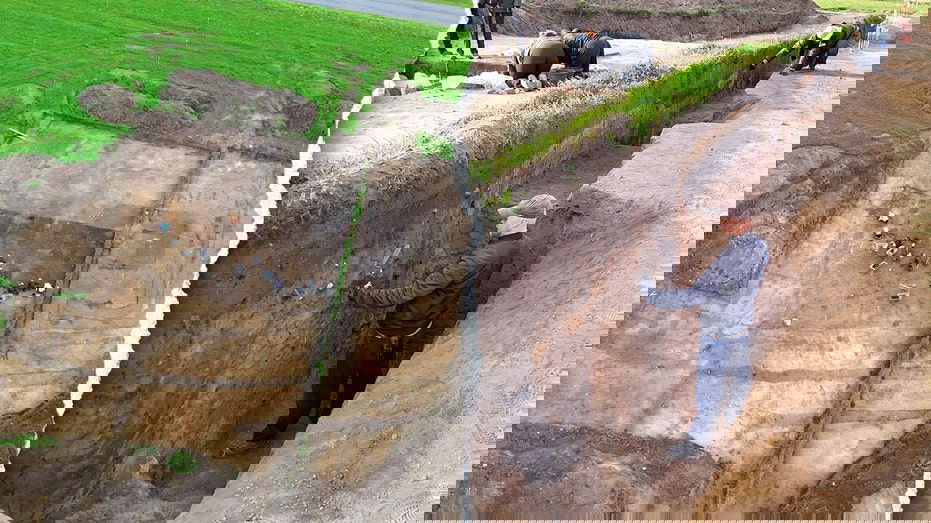
The Museum of Central Jutland (Museum Midtjylland) unveiled the discovery of the temple at Hedegård, an ancient site that contains Scandinavia's "largest and richest burial site," according to its website. The latest excavation began last August.
Hedegård, located near Ejstrupholm north of the Skjern River, has been identified as Denmark's largest settlement from the time "around the birth of Christ," the museum said.
Working with researchers from Museum Horsens and Moesgaard Museum, archaeologists found evidence of a vast fortified settlement that once served as a regional power center during the Iron Age.
Evidence shows the settlement "flourished in the period leading up to the birth of Christ."
The museum said that "this is when we see the rich graves and numerous weapon graves in the cemetery north of the village."
But the crown jewel of the excavation was the temple - which measured roughly 49 by 53 feet.
The structure had once burned down. Beneath the burn layer, excavators found traces of "two temple phases" that offer insight into its history.
"At the exact center was a [6 x 6 foot] raised clay platform," officials said.
"In the younger phase, an ornamented hearth was built here, partially covering the earlier hearth. The younger temple was shifted about [30 inches] north compared to the older one, but was otherwise nearly identical. The older hearth remained untouched - the new one was simply built over it."
Archaeologists also found plaster fragments that suggest the temple's walls were once painted white.
"The structure likely appeared as a tall, almost square, tower-like building with an outer colonnade. The hearth dominated the interior space."
The museum also said, "The temple was carefully cleared before being deliberately burned, leaving few finds. However, two exceptional glass beads were discovered - likely produced in the Middle East or Egypt."
The site has been the subject of scholarly interest since Danish archaeologists found an unusual number of richly-adorned graves in the late 1980s.
"It remains unique in Northern European archaeology - an early and unparalleled display of military, economic, and religious power," the museum's statement said.
Since the site was discovered over three decades ago, archaeologists have known that the site was "something completely different," said Martin Winther Olesen, an archaeology curator.
"When our geophysical surveys revealed a fortification in the village it was clear that this was something out of the ordinary," he noted.
Evidence appears to suggest that Hedegård was only in use for three generations before it disappeared.
All the evidence proves Hedegård had "everything it takes to be an early Iron Age power center," said Olesen - and he said that he could talk about the site "for two hours straight."
"The site is strategically located and controls the most important road up through Jutland," the expert said. "There is clear militarization in the form of weapons, but also in the construction of the fortification."
He added, "There is a political elite, monumental construction, there are crafts and trade and - of course - it is also a center for the practice of the cult."
The official noted the discovery was only made possible thanks to "super talented archaeologists and researchers from Denmark and abroad."
you may also like

- by foxnews
- 18 Mar 2026
Budget airline blasted in viral video as 'perfect honeymoon week' ends in travel chaos

- by foxnews
- 18 Mar 2026
Wealthy golden visa holders evacuated from UAE as Iran conflict escalates

travel
- by foxnews
- descember 09, 2016
Temple from time of Christ reveals powerful society lost to history, archaeologists say
Archaeologists uncovered a 2,000-year-old temple in Denmark at Hedegård, revealing insights into a mysterious Iron Age power center with luxury goods and Roman connections.
read more