- by foxnews
- 22 Sep 2026
MORNING GLORY: The best case for AI? Let it decide who gets into college
A workforce of at least 40,000 college admissions employees could face replacement as AI proves capable of sorting GPAs, test scores, and essays.
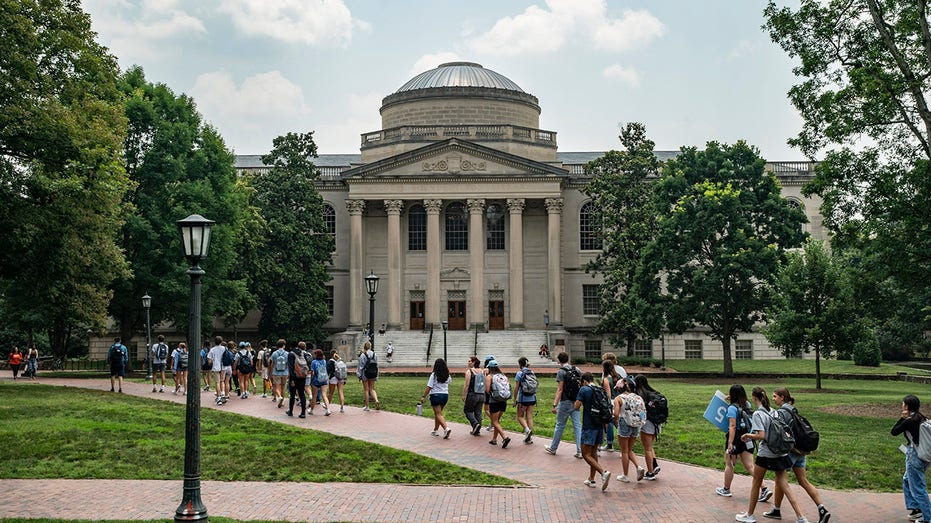
There is a debate about whether the widespread adoption and application of artificial intelligence models will cost jobs, and if so, in which industries.
If some obvious employment categories can be identified as ripe for replacement by AI, patterns should emerge about which sorts of jobs are in immediate peril.
One obvious candidate for replacement by AI is the staff of admissions offices at the nation's colleges and universities. There are not enormous numbers of these positions, but there are excellent reasons to put AI to work in those offices, and not just to save money in the budgets of increasingly beleaguered schools.
The College and University Professional Association for Human Resources released a study in April 2023 of 12,042 admissions employees at 940 institutions. On average, there were more than a dozen admissions staff members at every institution. There are more than 4,000 degree-granting institutions in the U.S., so a workforce of at least 40,000 is a reasonable estimate of the size of one group AI is coming for. (Even at the institutions where cost-cutting pressure is highest, there will still be a need for a couple of admissions officers, so don't project a 100% loss of jobs here.)
Why the focus on the staffs of admissions offices?
Because the college and graduate application process is driven by paper and numbers: test scores, GPAs, essays, resumes, and recommendations from tens of thousands of young people all aiming for a prized result. Almost all of the applicants share a hope for a fair process.
The sorting and scaling of numbers-GPAs and test scores-are exactly what AI can compile and assess in hours, if not minutes. If AI is even a tenth as powerful as advertised, it should be able to sort resumes and recommendations by truthfulness, quality, and sincerity. Essays can be combed through for originality as well as for evidence of outside assistance.
AI can also be given weights for factors that are legitimate indicators of merit beyond academic achievement, such as in-state/out-of-state status, gender, family income, the difficulty of life circumstances, and the need for broad geographic and class diversity. AI models can also be trained to evaluate grades and performance based on the nature of the secondary school or college attended.
AI models can be instructed not to give any weight to applicants' race, ethnicity, or religion-characteristics whose use in admissions is restricted by federal law and Supreme Court precedent.
Athletic ability and legacy status are legitimate factors, as are musical and theater talent, forensics, foreign-language fluency, and many more characteristics. Indeed, AI is going to be a far better agent for modeling an incoming class and targeting the long-term success of that applicant pool on that campus and in later lives than the work of young admissions officers.
AI could also be used to assure many constituencies-donors, evaluators of colleges, and, yes, courts-that the admission process is not tainted by the use of prohibited screens. Indeed, a school that wants a pretty airtight defense against suits challenging its admissions process for relying on prohibited-by-law factors such as race should be greatly assisted by laying out its own AI model's weights, even if the model's results aren't the final word on admissions.
Schools have to worry about many factors beyond academic chops, including the ability to pay tuition, the likelihood of employment after graduation, and the likelihood of any particular applicant becoming a financial supporter over the years.
Reputation matters greatly, too, as the benefit of network effects for a student body is a real thing. AI can, of course, be coached to weight markers for all these things, including how much an applicant has worked and whether he or she is a first-generation college student-two indicators generally thought to be predictive of life success.
What about those 40,000 employees for whom AI is like a great white shark just offshore?
Everyone, including them, would be better served doing work that can be objectively evaluated and that does not encourage the exercise of subjective judgment.
AI should be welcomed in any job category where a mass of data must be objectively analyzed. At a minimum, colleges and universities should want to deploy a parallel admissions process run by AI alongside their existing structure. How interesting and illuminating would a side-by-side comparison of accepted applicants be?
you may also like


- by foxnews
- 22 Sep 2026
Italian PM pushes foreign student cap in classrooms, burqa, niqab ban in schools

travel
- by foxnews
- descember 09, 2016
Americans warned again to rethink travel as missile attack rattles historic region
A Houthi ballistic missile targeting Riyadh over the weekend prompted the State Department to renew warnings to Americans of potential flight cancellations and airspace closures in key areas.
read more