- by foxnews
- 04 Apr 2026
Australian farmers await overseas workforce as locals are too ?spoilt for choice? - The Guardian Australia
Australian farmers await overseas workforce as locals are too ‘spoilt for choice’ - The Guardian Australia
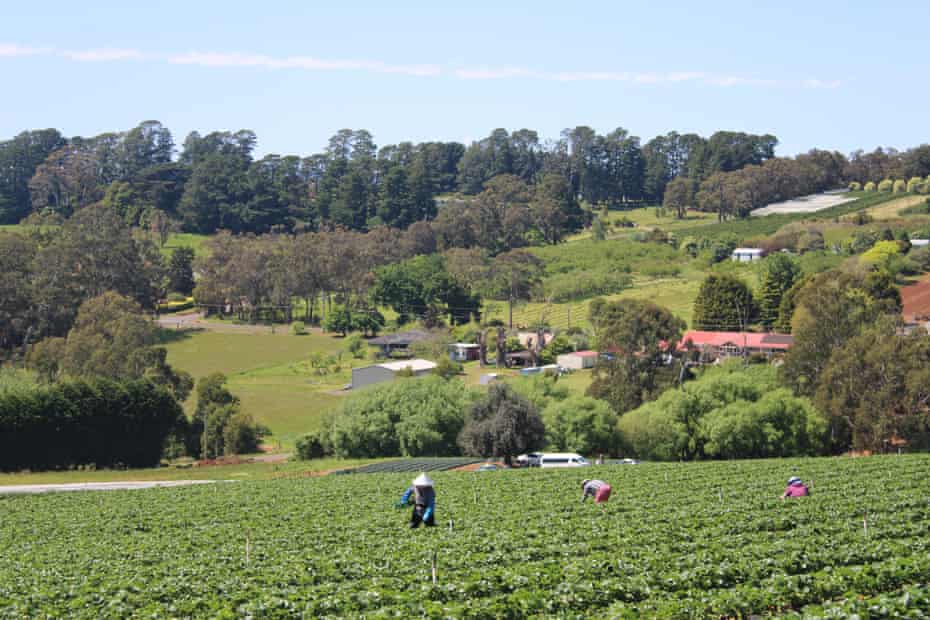
A microcosm of Australians’ reluctance to work on farms can be seen in Victoria’s Yarra valley.
CEO of a group of strawberry farms, Miffy Gilbert, struggled to source labour for the current harvest, while her teenage son works as a shelf-stacker at a supermarket.
Australians aren’t lazy, according to Gilbert, we’re simply spoilt for choice in a situation mirrored in most developed countries.
Gilbert is also CEO of AusBerry Farmers, a collaborative farming effort between seven families in the Yarra valley.
The Australian Bureau of Agricultural and Resource Economics and Sciences is predicting record production values for a second year in a row. The bureau is also reporting a shortage of about 22,000 workers across the country over the next quarter, with 16,000 of these in horticulture. Closed borders have exacerbated the shortage, as has the Australian-UK trade deal in June which removed the farm work requirement for about 10,000 British backpackers to extend their working holiday visas.
Gilbert started sourcing labour almost as soon as the previous harvest finished. She thought she might scrape through.
“It’s probably a major issue during the first couple of months up to Christmas, when the picking is fast and furious, and there are larger volumes.
More than $60m worth of crop losses have been self-reported by farmers nationally since mid-2020, but the actual figure is likely to be far higher.
The federal government’s response has been two fold: try to attract Australians to take up farm work, in conjunction with overseas seasonal workers.
An agricultural visa has long been on the horizon. The prime minister, Scott Morrison, promised in June to have the visa in place by the end of the year, after the announcement of the UK trade deal, but details remain vague.
The other potential solution was an incentive of $6,000 for Australians to relocate for work. Former deputy prime minister, Michael McCormack, even noted the Instagram opportunities for young Australians in regional locations.
Earlier this year I picked grapes on a farm in Western Australia, after satisfying the requirements of the federal government’s relocation assistance to take up a job program, (since rebranded as AgMove).
My correspondence with Harvest Trail Information Services (HTIS) began in mid-December 2020. Despite an extensive paperwork trail, I am yet to receive a cent of the incentive, despite picking my last grape more than seven months ago.
Maddy Muller and Riley Harrington, originally from Bendigo, are in the same boat.
Gilbert is optimistic about what the visa will offer, but says diversifying is key when it comes to sourcing labour.
“We’re probably looking to spread our risk, and not have all our eggs in one basket. Our workforce are great people who all work really hard. We’d love to have some more backpackers, but there aren’t too many in this area.
Not all are as buoyant. Deputy program director of migration at the Grattan Institute, Henry Sherrell, specialises in labour markets and immigration policy.
While acknowledging the agricultural visa’s obvious benefits, Sherrell fears it also has the potential to expose migrant workers to the sort of exploitation parts of the industry have been infamous for in the past.
Australian Workers Union national secretary, Daniel Walton, is more blunt.
“This visa will undermine the current Pacific labour scheme and the seasonal worker program. Apparently the meagre protections offered to Pacific Islanders under these programs are too luxurious, so the government is keen to offer a visa under which abuse is even easier.
Sherrell believes that while it has been a tough few years for labour-intensive farms, there is light at the end of the tunnel.
“This is a balancing act, and I worry that if we go too far down the path of trying to solve everything with more people and more visas, it will lead to more exploitation, and longer term, a less productive way of doing things.
you may also like


- by foxnews
- 04 Apr 2026
Homan vows immigration mission 'won't skip a beat' as Bondi exits DOJ


travel
- by foxnews
- descember 09, 2016
Americans warned of potential attacks at vacation destination as border crossing exit fee doubles
The U.S. Embassy Cairo issued a security alert for Americans in Egypt. The action follows regional military operations in Iran and rising border exit fees.
read more