- by architectureau
- 04 Mar 2026
Hobart's Forest dome reopens as UTAS campus
The iconic domed former Forestry Tasmania headquarters in Hobart has been transformed into a campus of distinct learning spaces, designed with a circular approach to building materials.
- by architectureau
- 08 Feb 2026
- in architects
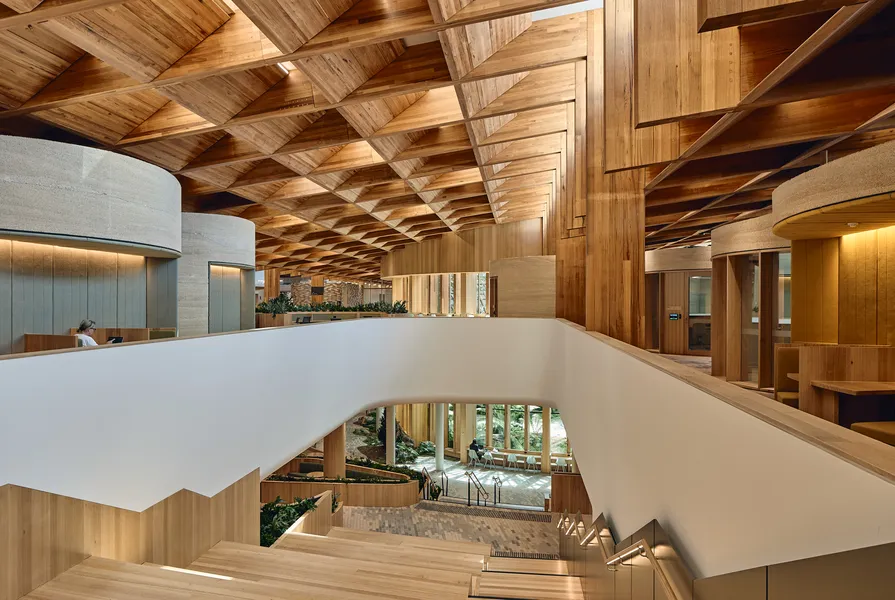
The Forest, the University of Tasmania's (UTAS) flagship Hobart campus, has reached completion, with staff and students now moving on site for classes scheduled in late February.
An opening ceremony on 6 February was attended by university staff and project partners. Designed by Woods Bagot, with landscape architecture by Realm Studios, the project revitalises and adaptively reuses a Melville Street site featuring heritage-listed brick warehouses that once served as a dry timber store and sawmill outlet. The redevelopment transforms the site into a campus of distinct learning environments.
A 1997 redevelopment by architect Robert Morris-Nunn converted the site into Forestry Tasmania's headquarters and introduced an iconic glass dome housing a lush indoor forest. The site was acquired by UTAS in 2018, and the forest has since been reinstated as part of the Woods Bagot and Realm Studios redevelopment.
The Forest redevelopment is conceived as a connected masterplan that weaves together existing structures and new interventions through integrated landscape, through-block connections and publicly accessible thoroughfares.
Woods Bagot design director Bruno Mendes said, "We're creating a campus, not a building, so we wanted to think about the interstitial, the relationship between zones and the quality of the spaces that you move through between buildings. We created clear navigation through the site, carving out spaces that create opportunities for the interaction of diverse demographics."
Approximately 300 staff and 3,000 students will be based in The Forest, which will also be open to the community as a study hub. According to a media statement from Woods Bagot, the campus features distinct educational spaces tailored to different learning modes, including focused study zones, 'alone together' spaces, public collaboration areas, private collaboration areas, relaxation quarters, and places for interaction.
The campus also includes spaces for local businesses, industry and government to engage and collaborate with university students and staff.
Woods Bagot notes that the redevelopment has retained all heritage elements and 60 percent of the overall existing structure on site. Targeting 40 percent less embodied carbon than comparable buildings, the project adopts a circular approach to building materials, with recovered timber reused for flooring, stair treads, ceiling linings and landscape elements.
The statement emphasises that new materials were selected for low environmental impact and provenance, including mass-timber construction, carpets made with recycled content and locally sourced materials. The new internal structure is demountable, allowing spaces to be reconfigured over time to meet changing needs.
Additionally, the Forest Building is described by the project team as the largest commercial application of hempcrete - a material that absorbs and stores carbon - in Australasia.
"Working with found conditions, we have strived to emphasise the existing and let that drive the conceptual direction of the new. What was added was rigorously scrutinised against a criteria of necessity, sustainability, and reusability at end of life, making it exemplary in circularity and sustainable building design," said Mendes.
Vice-chancellor of UTAS, Professor Rufus Black, said The Forest would provide access to enhanced learning experiences and job opportunities for Tasmanians.
"It's a place for the community to experience their university, either as visitors or as students. This is where students, staff, businesses, and community members can share ideas and experiences in a welcoming and accessible space for all," said Black.
"In The Forest, our commitment to face-to-face learning is clear. From the large classrooms to the comfortable study nooks, the building is a place for learning, where students spend time with their peers, teachers and the community."
The Forest has already received the Future Project: Education award at the 2024 World Architecture Festival (WAF) and won the Building Technology category at the 2024 WAFX prizes.
you may also like
- by architectureau
- 04 Mar 2026
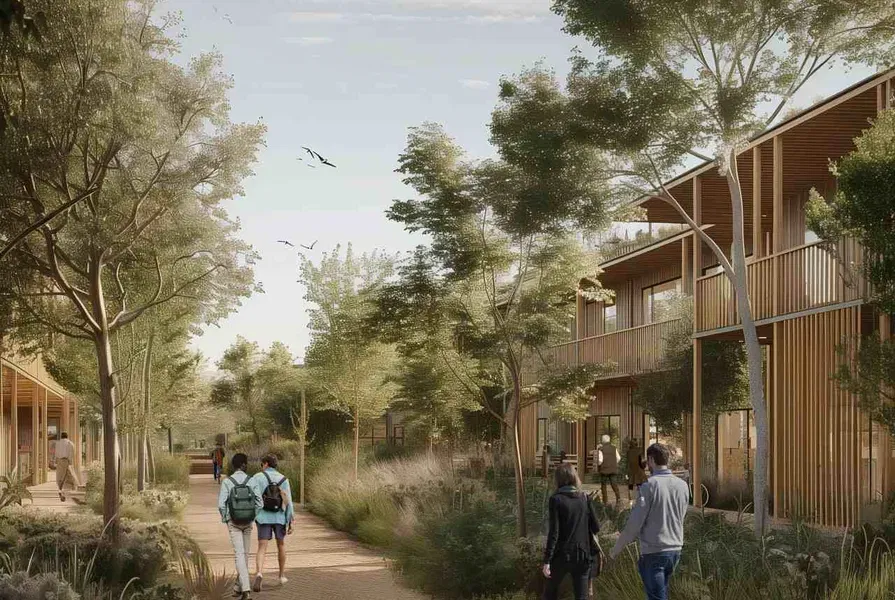
Nightingale to deliver 70 townhouses on former rail spur in Melbourne
- by architectureau
- 03 Mar 2026
Melbourne




travel
- by foxnews
- descember 09, 2016
Priceless ancient golden helmet stolen in Dutch museum heist recovered a year later
More than a year after a priceless ancient helmet was stolen from a museum in the Netherlands, the Romanian national treasure, along with two gold armbands, has been recovered.
read more